Here is an episode of the show Disney Family Album , one that is about one of the studio's greatest animators, Disney's equivalent to Bob McKimson. He is the one responsible for bringing Pinocchio, Shere Khan, and Madame Medusa to life on screen. He was the one the other animators turned to for advice on their work. I hope you enjoy.
Part 1
Part 2
Part 3
Until Next Time
Sunday, August 31, 2008

Sunday, August 24, 2008
My Defense of Disney's "Alice in Wonderland"
 I have heard many criticisms laid against Disney's Alice in Wonderland by many critics, especially animation historians and critics. As some have read in one of my earlier posts, I feel that Alice is one of Disney's greatest triumphs. I shall do my best to defend my opinion.
Criticism #1: Alice is an unsympathetic character and lacks the heart of Snow White or Cinderella
Response: I find Alice to actually to be a bit more sympathetic than the other two Disney heroines. For one thing, Alice is a bit more realistic in her personality. She has her flaws, like how her curiosity overcomes her common sense, or her short temper. This allows her to participate in the story, not just fulfill the a story point. This is what I felt was one of the biggest weaknesses of Snow White and the Seven Dwarfs. Snow White was not a believable, or interesting, character, just a plot device to allow the story to move along. It is my opinion that if you got rid of Snow White and her Prince, you would have a much better movie. In Alice, the title character adds to the film. She is the counterbalance to all of the insanity, and she will often get herself into trouble, such as towards the end when she insulted the Queen of Hearts without being aware that she was shrinking. Alice's inattentiveness to her surroundings puts her danger, her own personality flaws, not that of her wicked stepmother (ooga-booga) or of the other characters.

Criticism #2: Alice in Wonderland is too episodic, it has no real plot to speak of.
Response: I think I'll let Wikipedia answer this one: "Disney's final version of Alice in Wonderland followed in the traditions of his feature films like Fantasia and The Three Caballeros in that Walt Disney intended for the visuals and the music to be the chief source of entertainment, as opposed to a tightly-constructed narrative like Snow White or Cinderella. Indeed, Lewis Carroll's Alice books have no real plot to speak of, and because of the literary complexity of Carroll's work, they are essentially unfilmable. Instead of trying to produce an animated "staged reading" of Carroll's books, Disney chose to focus on their whimsy and fantasy, using Carroll's prose as a beginning, not as an end unto itself."
Criticism #3: The film version contains none of Lewis Carroll's satire
Response: Most of the humor and satire comes from the narrative, not the characters themselves. Now, I'm pretty sure a narrator constantly relating all the events to the audience would be quite annoying after a short while. However, you can find pieces of satire in the film. First off, look at the scenes with the Dodo and Bill the Lizard. It can be as a semi-biting comment on how the aristocracy takes advantage of the working man. However, the shining example is the court scene at the end of the film. What was probably a sardonic take on the Victorian justice system takes on a whole new meaning in the early nineteen-fifties. I don't think I need to say anymore.
That's about all I got. If anyone would like to discuss, just drop me a line.
Until next time
Wednesday, August 20, 2008
Disney's Animation Archive
I've found a website that has a lot of treats for Disney fans everywhere. It is called The Disney Animation Archive. It is an unofficial website, but it's filled with so many goodies.
Such special delights include:
Concept Art


Model Sheets:


Posters:


For more like this, just go here: http://animationarchive.net
Until Next Time
Such special delights include:
Concept Art


Model Sheets:


Posters:


For more like this, just go here: http://animationarchive.net
Until Next Time
Monday, August 18, 2008
The Art of Jim Steranko's "Talon"


According to The Jim Steranko Website: "Steranko created a barbarian hero for Marvel Comics named Talon. Marvel rejected Steranko's concept and Jim planned to publish Talon on his own. Although that graphic story has yet to materialize, some great drawings were produced"
For more great Steranko artwork, including a great story called The Block , go here:
http://www.thedrawingsofsteranko.com/
Until Next Time
Wednesday, July 16, 2008
Helen Kane: America's "Boop-Boop-A-Doop" Girl
Helen Kane is, if known at all, is best known for her influence in the creation of an international animation superstar. Caricaturing her likeness, along with Clara Bow, Fleischer animator Grim Natwick created Betty Boop. However, she was an incredible singer and entertainer during the heyday of the flappers. She was on top of the world until the Great Depression. After that, she was relegated to playing in nightclubs until her death in 1966. During the early thirties, Helen Kane sued the Fleischer's for the unfair competition, and I believe copyright infringement, but the judge ruled against her, saying Kane couldn't prove she invented her style of singing. Enjoy.
Sunday, July 13, 2008
A Little Inspiration
Nothing really special, just a little comedic inspiration from our friends across the pond in Ireland. Now, here they are, straight from Craggy Island: Father Ted and crew.
Part 1
Part 2
Part 3
Until Next Time
Happy Trails
Part 1
Part 2
Part 3
Until Next Time
Happy Trails
Monday, June 9, 2008
Steve Ditko
Today's post is about a man who I consider to be among the greatest artists of all time, especially among the world of comic books. His work is high up there on one of my greatest influences. Of course, I am referring to the great Steve Ditko. Below is one of the few known existing photographs of the man. He is an intensely private man, refusing to give an official interview since 1966.
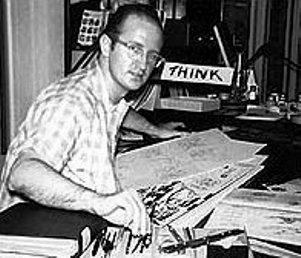
One reason he says he doesn't give interviews is because he "wants the work to speak for itself". Among his vast work from the 1950's onward consists of soem of the wildest and most imaginitive characters known to comics, including:
The Question
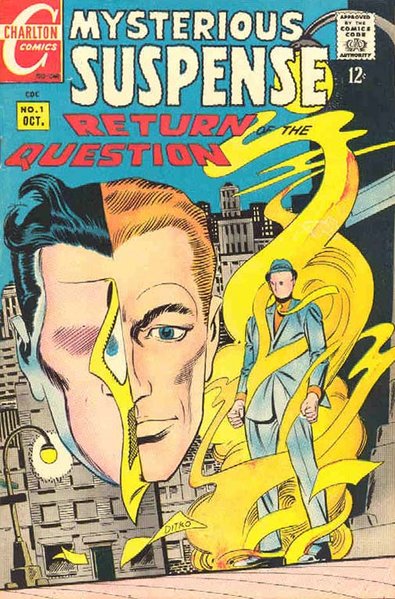
The Hawk and the Dove

The Creeper
Dr. Strange, Master of the Mystic Arts


And of course, everyone's favorite wall-crawler

One of the reasons I love his work so much is because his work has a lot of expressionism. The way he draws his characters makes them seem alive, but he does it in a different way than the way Kirby does it. Kirby does a lot of dramatic posing with his characters, done in a very overly dramatized manner. Ditko brings his characters to life through use of camera angles, moody atmosphere, and wonderful facial expressions. I think it would behoove every comic book artist working today to study his work and learn from him.
One of the things I've always noticed about Ditko's work, especially during his run on Spiderman, was that everybody looked incredibly anxious, often looking like they're just about to have a horrible nervous breakdown. I think that actually fit the Spiderman comic, because, let's face it, a lot of those stories were very depressing. Also, I think it just fit the time period as well. Think about it, it's 1963, we just went through the Cuban Missile Crisis, but we're still living with the fear of nuclear annihilation. I think an artist who could represent those feelings would strike a chord with readers. I think all artists strive for that, striking an emotional core with a reader or viewer.
I may not agree with his politics, but damn it all if he's not one of the greatest artists and storytellers of all.
Here are a few places to find out about this great artist:
Steve Ditko's website (operated by Blake Bell)
http://www.ditko.comics.org/
The BBC Documentary In Search of Steve Ditko http://www.dograt.com/category/cartooning/comic-books/in-search-of-steve-ditko/page/2/
This documentary includes interviews with comics masters such as Alan Moore, Neil Gaiman, John Romita Sr. (his replacement on Spiderman), Marvel editor Joe Quesada, as well as the one and only... Stan "The Man" Lee. I hope you enjoy.
Until next time,
Happy Trails
Subscribe to:
Posts (Atom)